1
Read the ski area, not the village
What matters is the height and spread of the terrain above your bed, and whether one pass links it together.
The Alps run for some 1,200 kilometres from the Mediterranean to Vienna, and the ski areas built on them ignore the borders that cross them. Compare what each country actually gives you, then search resorts, dates and accommodation with our ski travel partner.

Compare resorts, dates and accommodation in France, Austria, Switzerland, Italy, Germany and Andorra directly below, powered by our ski travel partner.
GlobeSaga works with SnowTrex, a specialist ski travel partner, to power this search. We may earn a commission on bookings made through it.
Snow falls on the same weather systems from the Dauphiné to the Tyrol, but a week in a French purpose-built resort at 2,300 metres and a week in a Bavarian market town below 1,000 metres are different holidays with different prices, different journeys and different odds on cover in a warm winter. This page sets out those differences plainly, so the resort you book matches the trip you had in mind.
What matters is the height and spread of the terrain above your bed, and whether one pass links it together.
A cheap flight can be followed by a three-hour coach on a Saturday. Trains reach some resorts and not others.
Lift pass, hire, lessons, lunch and transfer often add more than the difference between two hotels.
Named areas below are real and checkable. Piste kilometres are the operators' own published figures and are useful for comparison rather than as an exact measure.
France holds the largest and highest linked ski areas in Europe. Les Trois Vallées connects Courchevel, Méribel, Les Menuires and Val Thorens on a single pass covering some 600 kilometres of marked piste. Val Thorens itself sits at 2,300 metres, the highest resort village in Europe, which is the plainest reason French skiing holds its snow late.
Beyond it: Paradiski joining Les Arcs and La Plagne; Tignes and Val d'Isère sharing the Grande Motte glacier; the Portes du Soleil, which runs across the Swiss border above Morzine and Avoriaz; and Alpe d'Huez and Serre Chevalier further south. The trade is architectural: much of that altitude comes from resorts built for skiing in the 1960s and 1970s, not from old villages. If you want the village first, look to Chamonix beneath Mont Blanc, or to Megève.
GlobeSaga has a dedicated guide to skiing in France, and lake-and-mountain guides to Chamonix and Annecy.

Ski Arlberg is the country's largest linked area: roughly 305 kilometres of piste tying together St. Anton, St. Christoph, Stuben, Lech, Zürs, Warth and Schröcken, with the Valluga at 2,811 metres as its high point. Elsewhere the range is broad rather than tall: Sölden in the Ötztal with its glacier terrain, Ischgl on the Swiss border, the SkiWelt around the Wilder Kaiser, Saalbach-Hinterglemm, and the Zillertal, where the Hintertux Glacier runs lifts all year.
Kitzbühel is the reminder that Austrian resorts are often proper towns with a life outside the lift queue — and that its famous Streif race course starts at 1,665 metres, below the village altitude of several French resorts. Village bases are generally lower here than in France, so snowmaking coverage and a north-facing aspect matter more when you compare two areas.

Zermatt sets the tone: a car-free village reached only by train, under the Matterhorn, with the Matterhorn Glacier Paradise lift topping out at 3,883 metres — the highest lift-served point in Europe — and glacier skiing available in every month of the year. Its ski area continues over the ridge into Breuil-Cervinia in Italy, so a day's skiing can cross a border and come back.
Elsewhere: Verbier in the Valais, Davos and Laax in Graubünden, St. Moritz in the Engadin, and the Bernese Oberland trio of Grindelwald, Wengen and Mürren beneath the Jungfrau, where the Lauberhorn downhill is run each January. What you pay for is altitude, grooming, punctual lifts and the fact that the train really does go there.

Italian skiing splits in two. In the north-east, the Dolomites are covered by the Dolomiti Superski pass: twelve valleys, roughly 1,200 kilometres of piste and around 450 lifts on one ticket, running from about 1,000 metres up to 3,342 metres on the Marmolada. The Sella Ronda circles the Sella massif over the Gardena, Sella, Pordoi and Campolongo passes and can be skied in a day. Val Gardena, Alta Badia and Cortina d'Ampezzo — which hosted alpine events at the 2026 Winter Olympics alongside Milan — are the familiar names.
In the north-west the mountains are Alpine in the strict sense: the Aosta Valley, with Courmayeur on the Italian side of Mont Blanc and Breuil-Cervinia under the Matterhorn, plus Sestriere on the Via Lattea and Livigno and Bormio in the Lombard Alps. Terrain leans towards long, sunny intermediate cruising rather than steep skiing, and lunch is generally the best on this page.
GlobeSaga also has a guide to skiing in Italy and an in-depth guide to the Dolomites.

Germany's share of the Alps is a narrow strip along the Bavarian border, and it is worth saying plainly that the ski areas there are lower and much smaller than everywhere else on this page. None of them offers a week of unrepeated terrain, and in a warm winter the lower slopes struggle. That is the honest starting point.
Garmisch-Partenkirchen is the largest. Garmisch-Classic reaches about 2,050 metres with roughly 40 kilometres of piste, including the Kandahar downhill course; separately, the Zugspitze — Germany's highest mountain at 2,962 metres — carries about 20 kilometres of high, treeless runs on the country's only glacier ski area. Oberstdorf in the Allgäu pairs the Fellhorn with Kanzelwand for around 36 kilometres that run over the border into Austria's Kleinwalsertal, and adds the Nebelhorn at roughly 13 kilometres. Around Berchtesgaden, under the Watzmann, several separate small hills including the Jenner, Götschen and Rossfeld add up to about 40 kilometres, none of it linked.

Andorra sits in the eastern Pyrenees, several hundred kilometres from the Alps. It belongs on this page because the same booking partner covers it and because it answers a question the Alps often answer expensively: a large, high ski area with generous beginner terrain at a lower price.
Grandvalira is the largest ski area in the Pyrenees, roughly 210 kilometres of piste between about 1,710 and 2,640 metres, spread across sectors above Canillo, Encamp, Soldeu and El Pas de la Casa. Pal Arinsal and Ordino Arcalís, the two areas once branded Vallnord, add most of the rest; a single Andorra Pass covers around 308 kilometres across all three. Ski schools teach routinely in English and Spanish, which is a genuine practical advantage for a first week.
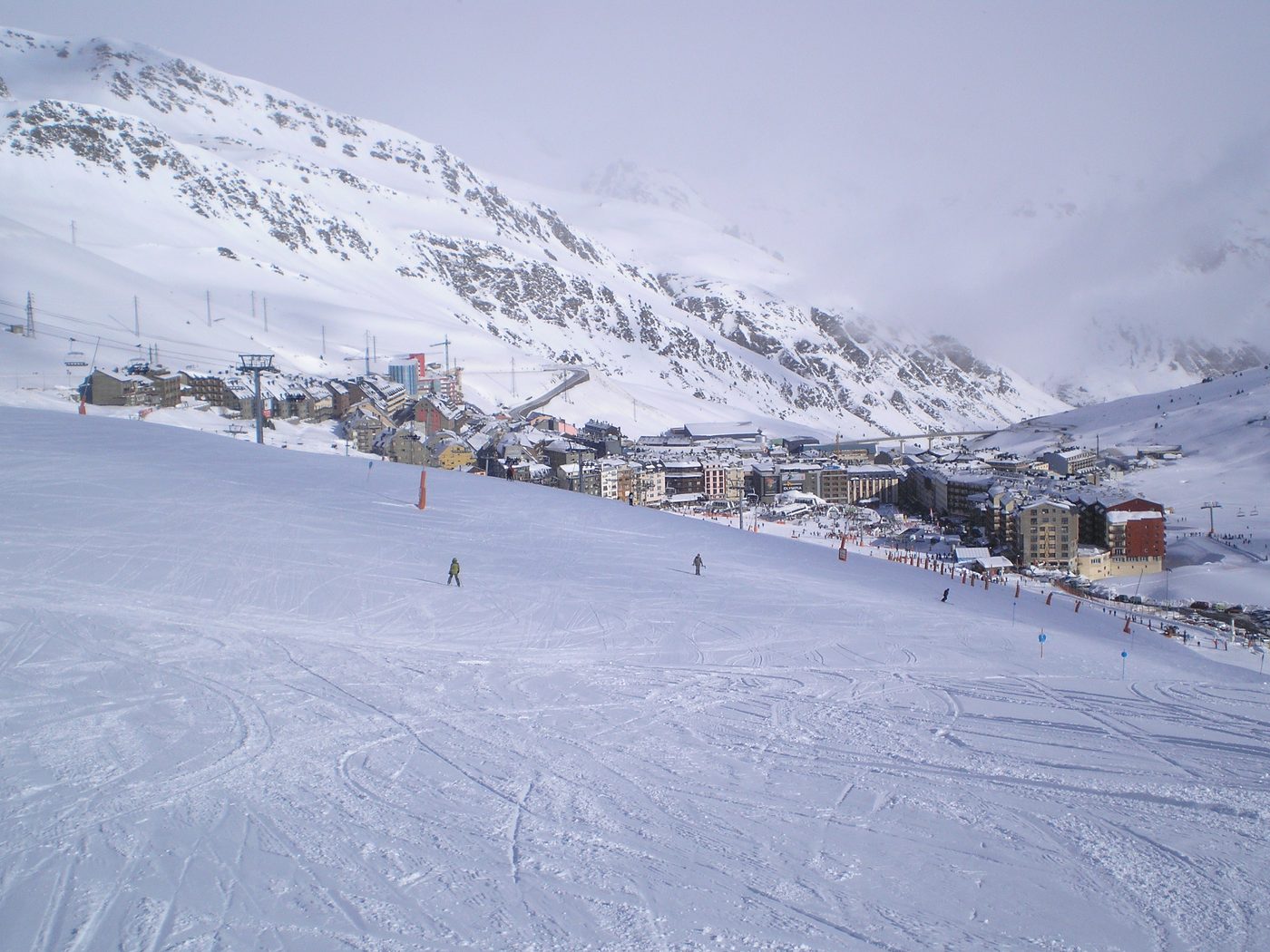
Most Alpine resorts open between late November and mid-December and close between mid-April and early May. Low villages close first and open last; high, north-facing terrain does the opposite. A handful of glacier areas sit outside that calendar entirely — the Hintertux Glacier in Austria and the glacier above Zermatt run lifts in every month, and Sölden and the Stubai normally start turning in late September or October.
There is no altitude that guarantees snow, but the odds improve markedly above roughly 1,800 to 2,000 metres, and again on slopes that face north and never see the February sun. This is not a small consideration. A 2023 study in Nature Climate Change modelled 2,234 ski resorts across 28 European countries and found that, without snowmaking, 53 per cent would face a very high risk of scarce snow at 2 °C of global warming, rising to 98 per cent at 4 °C. With snowmaking covering half a resort's pistes, those figures fell to 27 and 71 per cent — at a real cost in water and electricity.
Within the season, timing changes the price more than the snow. Christmas, New Year and the February half-terms are the most expensive and the most crowded weeks in every country here. Mid-January is usually the quietest good-snow window. Late season depends on where Easter falls that year, and on how high your terrain sits: in April, 2,000 metres is a different mountain from 1,200.
High purpose-built resorts hold snow and cut walking; old villages give you a place that exists in summer too. You can rarely have both at the same price.
The phrase covers everything from a door onto the piste to a ten-minute walk in boots. Check the stated distance to the lift and to a run you can ski home on.
Switzerland, Austria and the German Alps reward arriving by rail. France works with a fast train plus a bus. The Dolomites and Andorra effectively require a road transfer.
A group of confident skiers wants linked kilometres and a lift pass that opens all of them: Les Trois Vallées, the Arlberg, the Dolomiti Superski network. A family with small children wants the opposite — a short walk to a gentle slope, an English-speaking ski school, and somewhere to eat at four o'clock. Those two priorities pull towards different resorts, and trying to satisfy both usually satisfies neither.
If someone in the party wants to leave the piste, the question is not whether a resort has off-piste terrain, but whether it has the infrastructure around it: guides available at short notice, avalanche information you can actually read, and lifts that reach north-facing snow. Chamonix, St. Anton and Verbier have built their reputations on this; many perfectly good family resorts have not, and that is not a fault.
If you drive, know the rules before the border. France requires winter equipment — winter tyres, or chains carried in the boot — from 1 November to 31 March in designated mountain departments across the Alps and Pyrenees. Austria requires winter tyres from 1 November to 15 April whenever conditions call for them. Hire cars collected at an airport are not always fitted with them by default, so confirm at booking. GlobeSaga's car hire, flight and accommodation searches cover the other pieces of the journey.
Most resorts open between late November and mid-December and close between mid-April and early May, with the lowest villages closing first. A few glacier areas run far longer: Hintertux in Austria and the glacier above Zermatt operate year-round, and Sölden and Stubai normally spin from late September or October.
There is no single altitude that guarantees snow, but cover is generally more dependable above roughly 1,800 to 2,000 metres and on north-facing slopes. What matters more than the village altitude is the height of the skiable terrain above it, and how much of the area is covered by snowmaking.
Switzerland is consistently the most expensive. Austria and Italy usually sit in the middle, France varies widely between purpose-built apartment resorts and famous villages, and Andorra and the German Alps tend to be the cheapest. Lift pass, food and transfer costs all move the total, so compare the whole week rather than the headline accommodation price.
In Switzerland, Austria and the German Alps, yes — trains run to or very close to many resort villages, and Zermatt can only be reached by rail. In France, high-speed trains reach valley stations such as Moûtiers and Bourg-Saint-Maurice and a bus covers the last climb. In the Dolomites and in Andorra the final leg is always by road.
It depends what you want. German ski areas are lower and much smaller than those in France, Austria, Switzerland or Italy, and none of them offers a week of unrepeated terrain. What they do offer is very easy access: Garmisch-Partenkirchen is about an hour and twenty minutes by direct train from Munich. For a short break, a first week on skis or a family weekend, that convenience can be worth more than size.
The phrase is used loosely. It can mean a door that opens onto a piste, or it can mean a short walk in ski boots to a lift, sometimes uphill. Before booking, check the described distance to the nearest lift and to a run you can actually ski home on at the end of the day.
No. Andorra lies in the eastern Pyrenees, between France and Spain, several hundred kilometres from the Alps. It appears alongside the Alpine countries here because the same booking partner covers it and because it answers a similar question — a large, high ski area at a lower price — with a longer road transfer.
Country guides go deeper on individual resorts and valleys: skiing in France, skiing in Italy, the Dolomites in depth, and destination guides to Chamonix, Annecy and the Aosta Valley.
Loading photo credits…