Naxos town above the Grotta and Vintzi shore
A cheap country with three expensive islands

Greece on a Budget

Greece is one of the better-value countries in Europe, right up until you book the wrong island in the wrong week. Almost the entire difference between a cheap trip and an expensive one is made in four decisions.

Food, buses, ferries, museums and beaches in Greece are all cheap by western European standards. What is not cheap is a caldera room on Santorini in August, a high-speed catamaran booked at the last minute, or a hire car taken for a fortnight when you needed it for three days.

This guide is about the four decisions that carry the cost — when you go, which island you choose, which boat you take and where you sleep — followed by the small daily savings that matter rather less than people think. For the seasonal half of the arithmetic, read the best time to visit; for the boats themselves, read how Greek ferries work.

Biggest single savingTravelling in May, June or late September rather than August
Second biggestChoosing Naxos or Paros over Santorini or Mykonos
Cheapest crossingDeck class on a conventional ferry, booked early
Free daysFirst Sunday of each month, November to March, at state sites
A ferry in the harbour at Piraeus
Chapter 01

Take the slow boat, and book it early

Deck class · Conventional ships · High speed · Rafina · Booking

The gap between the cheapest and dearest way of reaching the same island is often three or four times the fare.

Deck class is a real option, not a punishment

Conventional ferries out of Piraeus sell an economy or deck fare that buys a seat in the public lounges and the run of the open decks. On a daytime crossing to Paros or Naxos that is all anyone needs, and it costs a fraction of the high-speed fare for perhaps two hours more at sea.

Reserved airline-style seats and cabins are the upgrades worth paying for on the overnight Crete sailings, where a berth replaces a hotel night rather than adding to one.

Where you sail from changes the price too

Rafina, twenty-five kilometres east of Athens, is closer to the airport than Piraeus and serves Andros, Tinos, Mykonos, Paros and Naxos. If your flight lands late morning, sailing from Rafina can save a night's accommodation in Athens.

Book the boats as soon as the dates are fixed. Greek ferry fares do not rise like airline fares, but the cheap conventional sailings sell out in August while the expensive fast ones do not.

Stalls inside the central market of Athens
Chapter 02

Athens costs very little if you stay out of the tourist grid

Athens · Markets · Metro · Walking · Neighbourhoods

The city is compact, the metro is cheap and the good eating is two streets off the route everyone walks.

Eat where the city eats

The central market on Athinas Street sells fish, meat and vegetables to the restaurants of the city and has cheap cook-houses inside it. The streets around it — Evripidou for spices, Sofokleous for mezedopoleia — are where a full lunch costs less than a coffee on a rooftop with an Acropolis view.

A wrapped Souvlaki remains the cheapest hot meal in Greece and is not a compromise. The bakeries are the other reliable saving: a cheese pie and a coffee is a normal Greek breakfast and costs a euro or two.

The transport that is already cheap

Two metro lines connect the airport, the centre and Piraeus, and the single ticket covers ninety minutes of travel with changes. The airport journey carries a supplement; everything else in the city does not.

Athens is also small enough to walk. The Acropolis, the Agora, Monastiraki, Psyrri and Plaka sit inside a square kilometre, and the pedestrian street that circles the rock is free and one of the best walks in the city.

A marble-paved lane in the mountain village of Apeiranthos on Naxos
Chapter 03

Choose the island the Greeks choose

Naxos · Paros · Milos · Villages · Rooms

The same week costs half as much one ferry stop from the famous names.

The price difference is the island, not the season

Santorini and Mykonos price accommodation on a scarcity that their neighbours do not have: a caldera view and a short season. Naxos, Paros and Milos have the same sea, better beaches and a fraction of the room rate.

Inland is cheaper again. Village rooms in places like Apeiranthos on Naxos or Lefkes on Paros cost less than the coast and put you in a working village rather than a resort strip.

Rooms, studios and the value of a kitchen

Family-run rooms and studios — signed as rooms to let — are the standard budget accommodation across the islands and are usually cleaner and better placed than the price suggests. A studio with a kitchenette pays for itself in breakfasts and cold drinks alone.

Book the first and last nights and improvise the middle if you are travelling outside July and August. In high summer, book everything: the cheap rooms go first and the expensive ones are what remains.

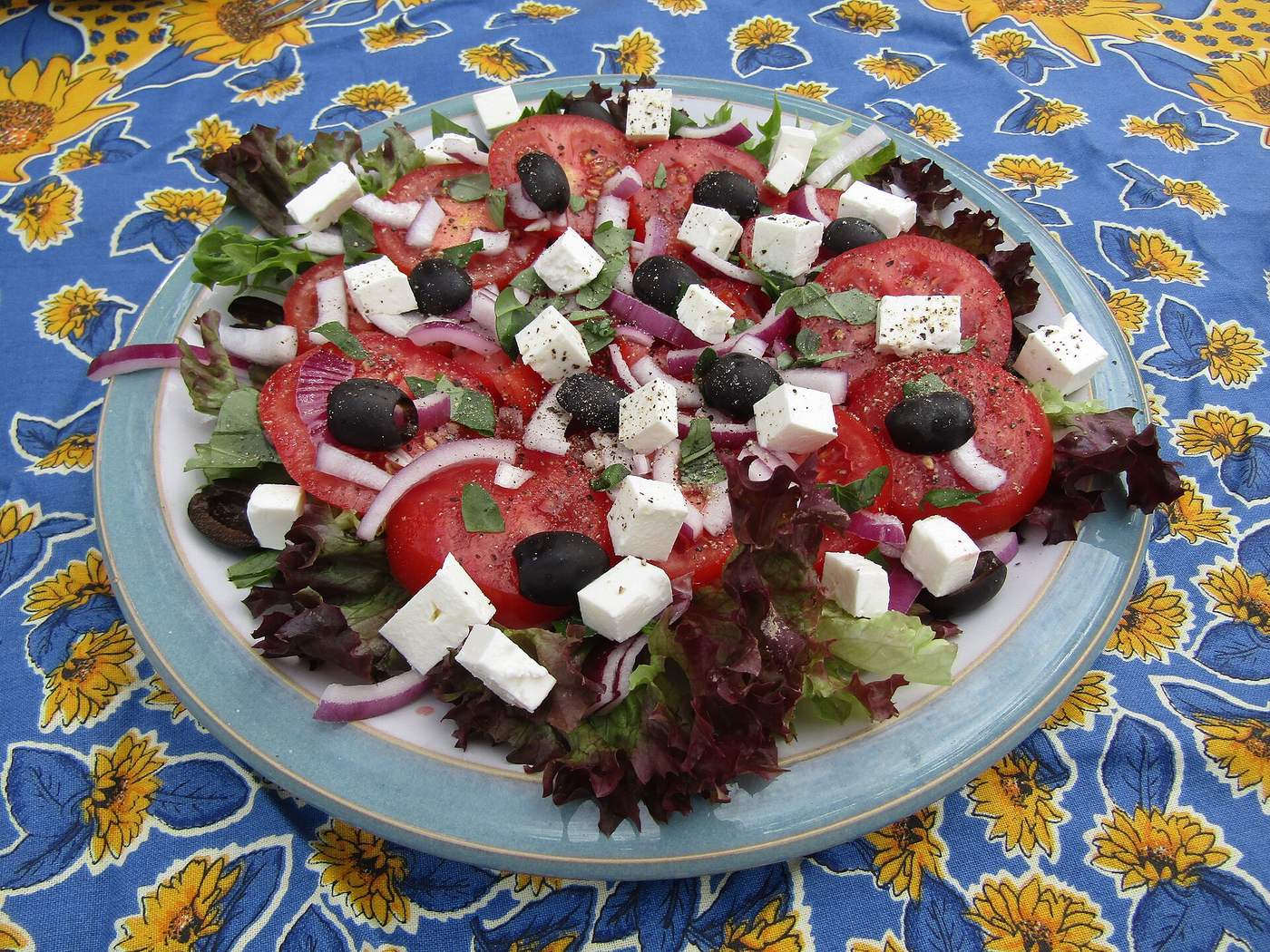
A Greek salad of tomato, olives and a slab of feta
Chapter 04

Eating out is the part you do not need to economise on

Tavernas · Meze · Carafe wine · Bread · The bill

A taverna dinner in Greece is already cheap. Ordering it the Greek way makes it cheaper and better.

Order for the table, not per person

Greek eating is several small dishes shared in the middle: a Greek salad, a plate of beans, whatever vegetable is cooked in oil that day, one grilled thing. Three or four dishes feed two people for the price of a single main course elsewhere in Europe.

House wine comes by the half-kilo or kilo carafe and costs a few euros. It is usually local, occasionally excellent and always cheaper than the bottle list.

Two things to watch on the bill

Bread and cover are charged per person almost everywhere, which is normal and small. Fish is charged by the kilo — ask what the piece weighs and what that comes to before it goes on the grill, and the surprise disappears.

The tavernas that show the day's cooked dishes at a counter rather than photographing them on a laminated menu are, almost without exception, both better and cheaper.

The Temple of Hephaestus seen across the Ancient Agora of Athens
Chapter 05

Ancient Greece is cheaper than it looks

Combined tickets · Free Sundays · Winter rates · Museums · Open sites

Entry fees are modest, several of the best sites are free, and the state runs a calendar of free days that almost nobody checks.

Free days and reduced winter rates

State-owned archaeological sites and museums admit everyone free on the first Sunday of each month from 1 November to 31 March, and on a handful of fixed dates through the year including 6 March, 18 May and 28 October. Admission prices at the same sites are lower through the winter season than in summer.

The Acropolis Museum is privately run and keeps its own list of free days, which does not match the state one.

Multi-site tickets and the sites that cost nothing

Athens sells a combined ticket covering the Acropolis and half a dozen other sites including the Ancient Agora and Hadrian's Library, valid over several days. If you intend to see three of them it is worth buying; if you only want the rock, it is not.

A great deal of ancient Greece has no gate at all: the Temple of Hephaestus is inside a paid site, but the Portara on Naxos, the Venetian harbour walls of Chania and most Byzantine chapels are simply there.

The weathered granite of Kolymbithres beach on Paros
Chapter 06

Beaches, sunbeds and the law that gives the sand back

Sunbeds · Beach law · Free space · Water · Buses

Since 2024 a large share of every organised Greek beach has to be left free of sunbeds — and using it costs nothing.

Seventy per cent of the beach is free

Greece's 2024 coastal law requires that at least 70 per cent of an organised beach stay clear of sunbeds and umbrellas, rising to 85 per cent on environmentally protected beaches, and it bans loungers within four metres of the waterline. Operators need a permit, and beaches in protected areas can be excluded from concessions entirely.

The state runs a reporting app, MyCoast, for beaches where the rule is being ignored. In practice: bring a towel, walk past the loungers, and the best part of the beach is usually the free part anyway.

Getting to them without a hire car

Island bus networks are cheap and run to the main beaches several times a day in season — on Naxos, Paros, Rhodes and Crete they are perfectly usable. Hire a car for two days of exploring rather than for the whole stay and the saving is immediate.

Scooters and quad bikes look cheaper still. They are also the commonest cause of holiday injury in the Greek islands, and hire insurance frequently excludes them.

What a day costs

Three ways to spend a week

Rough shapes rather than quotations — the point is the ratio between the columns, which is stable even when the numbers move.

StyleSleepingMovingEatingWhere it breaks
CarefulVillage rooms and studios, booked earlyDeck class, island buses, no carBakery breakfast, market lunch, taverna dinnerAugust, when the cheap rooms have gone
ComfortableSmall hotels in the harbour townsConventional ferries with reserved seats, car for two daysTavernas twice a day, carafe wineAdding a third island and a third set of transfers
Expensive by accidentCaldera or beachfront in high seasonHigh-speed catamarans booked late, car all weekRooftop restaurants with a viewIt does not break; it simply costs three times as much
Planning in detail

Six ways money leaks out of a Greek trip

None of these is dramatic. Together they are most of the difference.

Booking the fast boat by default

The catamaran can cost twice the conventional fare for two hours saved.

Take the slow boat in daylight.

A car for the whole stay

Most islands need one for two days, not seven.

Buses cover the main beaches.

Rooms with a caldera view

The view is the entire price difference on Santorini.

Sleep inland, walk to the rim.

Eating on the waterfront square

The same kitchen is cheaper one street back.

Follow the Greek families.

Airport transfers

The Athens metro and the X96 bus both reach the port for a few euros.

Taxis are for late arrivals.

Ignoring the free days

State sites are free on the first Sunday from November to March.

Check before buying tickets.

Before you book

The honest budget check

Six decisions that carry almost the whole cost of a Greek trip.

Month

August against June or late September is the biggest single lever.

Island

One ferry stop from the famous name halves the room rate.

Boat

Conventional and early beats high-speed and late.

Car days

Two, not fourteen.

Kitchenette

A studio pays for itself in breakfasts.

Free days

First Sunday, November to March, at state sites.

Honest planning

Frequently asked questions

Answers written to help you make a realistic plan, not to add more stops to it.

Compared with most of western Europe, yes — food, local transport, ferries and museum entry are all inexpensive. The exceptions are accommodation on Santorini and Mykonos in high summer, and last-minute high-speed ferry tickets, both of which can cost several times the equivalent elsewhere in the country.
Deck or economy class on a conventional ferry, booked as soon as your dates are fixed. It buys a seat in the lounges and the run of the open decks, costs a fraction of the high-speed fare and takes perhaps two hours longer to the central Cyclades.
Naxos, Paros, Milos and the larger Dodecanese and Ionian islands all cost markedly less than Santorini and Mykonos, and inland villages on any island cost less than the coast. The saving is largest on accommodation and barely exists on food, which is cheap everywhere.
Yes. State-owned sites and museums are free to everyone on the first Sunday of each month from 1 November to 31 March, and on several fixed dates including 6 March, 18 May and 28 October. Winter admission prices at the same sites are also lower than summer ones.
No. Since 2024 at least 70 per cent of an organised beach must be left free of sunbeds and umbrellas, 85 per cent on protected beaches, and loungers may not be placed within four metres of the water. Bring a towel and use the free space.
Buses, for most trips. Island networks reach the main beaches and towns several times a day in season. Hire a car for the two or three days you want to explore properly rather than for the whole stay, and book the smallest one available.
November to March on the mainland, when hotels are at their lowest and state museums have free Sundays. For a beach trip, late May, June and the second half of September carry most of the summer weather at a substantial discount to July and August.
Continue the story

Four decisions carry the whole budget

Month, island, boat and bed. Get those right and the rest of Greece is already inexpensive.

Advertisement