The Acropolis of Athens seen from the Hill of the Muses, with the Parthenon above the city
One hill, three thousand years, and a city built around both

Athens in Depth

The Acropolis is the reason most people come and the smallest part of what is here. Below it lie the marketplace where the classical city actually worked, a cemetery that records its dead, a Roman quarter, a nineteenth-century capital laid over the lot, and a port that still runs the Aegean.

Athens is usually read as a single monument with a city attached. It works better the other way round: a small plain in Attica with a defensible rock in the middle of it, settled since the Neolithic, fortified in the Bronze Age, and rebuilt as a showpiece in one extraordinary generation after the Persian wars. Everything since — Roman, Byzantine, Ottoman, Bavarian, modern — has been added around that same rock without ever removing it.

This guide takes the layers in order: the Acropolis and its slopes, the ancient city underneath the modern streets, the neighbourhoods that make a stay pleasant or unpleasant, the museums that hold everything the sites no longer contain, the capital built after 1834 and the port at Piraeus, and the handful of day trips that are genuinely worth the travelling time.

The rockParthenon 447–432 BC · Erechtheion 421–406 BC · Propylaia 437–432 BC
The two museumsNational Archaeological Museum · Acropolis Museum, opened 2009
The portPiraeus · metro Line 1 and, since 2022, Line 3
When to goApril to early June, late September to October
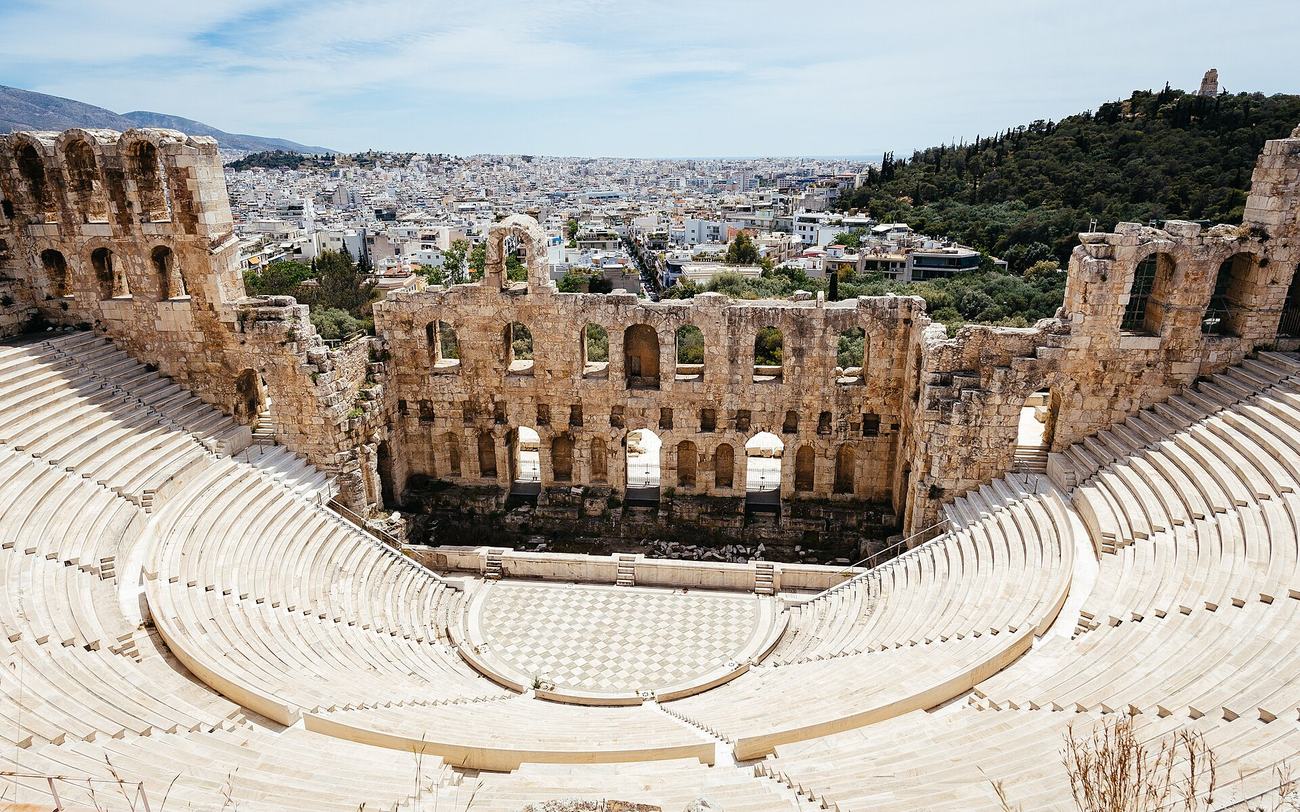
The Odeon of Herodes Atticus on the south slope of the Acropolis
Chapter 01

The rock, and the generation that rebuilt it

Pericles · Phidias · 447 BC · 1687 · The slopes

Almost everything on the Acropolis today was built in about forty years, and almost everything that has happened to it since has been damage.

Forty years of building

The Persians burned the sanctuary in 480 BC. Thirty years later Pericles put the rebuilding programme to the assembly, and between 447 and 432 BC the Parthenon went up in Pentelic marble under the architects Iktinos and Kallikrates, with the sculpture supervised by Phidias. The monumental gateway, the Propylaia, followed from 437 BC; the small Ionic Temple of Athena Nike sits on the bastion beside it; and the Erechtheion, finished in 406 BC, holds the porch of the Caryatids. Five of the six original Caryatids are in the Acropolis Museum, in a case you can walk around. The sixth is in London.

What ruined the Parthenon was not time. The building served as a church and then, after 1458, as a mosque, and it was substantially intact until 26 September 1687, when a Venetian shell under Francesco Morosini reached the Ottoman powder store inside and blew out the centre of it. The sculptures removed by Lord Elgin’s agents between 1801 and 1812, and sold to the British Museum in 1816, are the marbles still argued over today.

The slopes are half the site

The south slope is included in the Acropolis ticket and is regularly walked past. The Theatre of Dionysus below the rock is where the tragedies of Aeschylus, Sophocles and Euripides were first performed; what you see is mostly the stone rebuilding of the fourth century BC. A few hundred metres west, the Odeon of Herodes Atticus was built in AD 161 by the Athenian magnate Herodes Atticus in memory of his wife Regilla. Restored in the 1950s, it is a working theatre again and carries the summer programme of the Athens Epidaurus Festival.

West of the entrance the rock drops to the Areopagus, the council hill, and beyond it to the Pnyx, where the assembly of citizens actually met — a bare terrace with a speaker’s platform cut into the rock, and the best free view of the Parthenon in the city. The pine-covered hill opposite carries the Philopappos Monument, a Roman tomb of about AD 115 that is the reason the hill is on every postcard: it is where the photograph of the Acropolis is taken from.

The Ancient Agora and the rebuilt Stoa of Attalos seen from the Acropolis
Chapter 02

The ancient city underneath the modern one

Agora · Kerameikos · Hadrian · The metro dig

The Acropolis was the sanctuary. The city lived, traded, voted and buried its dead on the flat ground around it, and a surprising amount of that ground is open.

Agora, temple and cemetery

The Ancient Agora was the working centre: law courts, offices, workshops, the mint, and the colonnades where Socrates argued. Above it stands the Temple of Hephaestus, begun around 449 BC and the most completely preserved Greek temple anywhere, largely because it was a church until the 1830s. On the east side the Stoa of Attalos — a second-century BC gift from Pergamon — was rebuilt from the ground up between 1953 and 1956 by the American School of Classical Studies and now holds the site museum. It is the one place where you can stand inside an intact classical colonnade.

North-west of the Agora, Kerameikos is the ancient cemetery, the Dipylon and Sacred gates, and a long stretch of the Themistoclean Wall thrown up in 479 BC. It is the quietest classical site in the city and the easiest one to have almost to yourself.

Rome, and what the metro found

Hadrian rebuilt Athens as a showpiece of Greek learning. The Roman Agora with its octagonal Tower of the Winds — a first-century BC combination of sundials, water clock and weather vane — sits beside Hadrian’s Library of AD 132. The arch he raised still carries its two inscriptions, one naming the city of Theseus on the old side and one naming the city of Hadrian on the new. Behind it the Temple of Olympian Zeus was begun by the tyrant Pisistratus in the sixth century BC and finished by Hadrian in AD 131, some six hundred and fifty years late; fifteen of its columns stand and one lies where a storm dropped it in 1852.

The ancient layer is also under the platforms. Building metro Lines 2 and 3 through the centre in the 1990s produced one of the largest urban excavations ever run in Europe, and the finds were left where they are useful: Syntagma station displays a cut through the strata with a Roman aqueduct and graves in section, and Acropolis and Monastiraki stations show finds in the concourse. The metro is, in the most literal sense, a museum you pass through.

Whitewashed island-style houses of Anafiotika under the Acropolis rock
Chapter 03

Five neighbourhoods, and what each is for

Plaka · Monastiraki · Koukaki · Exarcheia · Kolonaki

Central Athens is small enough to walk across in an hour, and different enough street by street that where you sleep decides what kind of trip you have.

The old town: Plaka and Monastiraki

Plaka wraps the north and east slopes of the rock, and is the oldest continuously inhabited quarter of the city — nineteenth-century houses on a street plan much older than that. Its odd corner is Anafiotika: a cluster of whitewashed, flat-roofed Cycladic houses built into the rock from the 1860s by stonemasons from the island of Anafi, brought to Athens to work on King Otto’s palace, who built themselves the village they had left.

Monastiraki below it is the flea-market quarter, with the Tzistarakis Mosque of 1759 on the square and Hadrian’s Library across the road. The Little Metropolis, a small twelfth-century church built almost entirely out of recycled ancient and early Christian marble, stands a few minutes east. Psyri next door was a workshop district and is now where the city eats and drinks late.

Koukaki, Exarcheia, Kolonaki

Koukaki sits behind the Acropolis Museum on the south side: residential streets, neighbourhood tavernas, and a five-minute walk to the pedestrian promenade of Dionysiou Areopagitou. It is the quiet answer to the question of where to stay. Exarcheia, north of the centre beside the Polytechnic, is the city’s political quarter; the student uprising of November 1973 against the military junta began behind those railings, and 17 November is still marked every year. It is a neighbourhood of bookshops, cheap tavernas and hard argument, and it is changing quickly.

Kolonaki is the expensive one: galleries, embassies, and the three museums on and behind Vasilissis Sofias. Above it, Mount Lycabettus rises to 277 metres with a funicular up the back and a chapel on top. West of the centre, Metaxourgeio and Gazi — the old gasworks, now the Technopolis arts complex — are where the nightlife moved when Psyri filled up.

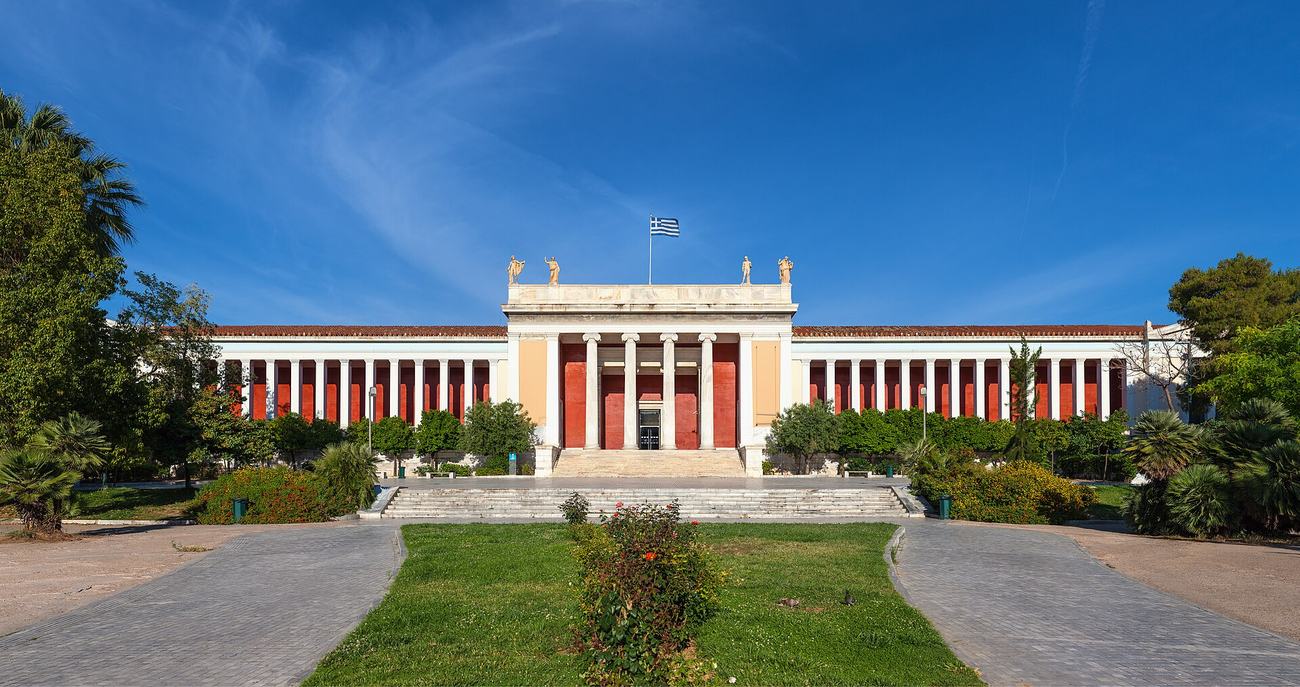
The neoclassical facade of the National Archaeological Museum in Athens
Chapter 04

The museums: where the sites keep their contents

National Archaeological · Acropolis · Benaki · Cycladic · Byzantine

Greek archaeological sites are stripped by design. Everything portable is in a museum, and in Athens that means five of them are not optional extras.

The two big ones

The National Archaeological Museum, in a neoclassical block north of Omonia, is the largest archaeological collection in Greece and covers the whole of it: the Cycladic marble figurines of the third millennium BC, the Mycenaean shaft-grave gold including the Mask of Agamemnon that Schliemann dug up in 1876 and misdated by three centuries, the bronze Artemision god pulled from the sea, some of the frescoes from Akrotiri on Santorini, and the corroded gearwork of the Antikythera mechanism, an astronomical calculator recovered from a shipwreck in 1901 and about fourteen centuries ahead of anything comparable.

The Acropolis Museum, opened in 2009 to a design by Bernard Tschumi with Michael Photiadis, does one job extremely well. It is built on stilts over an excavated ancient neighbourhood, which you walk above on glass floors, and its top-floor gallery is a steel box set at the exact size and compass bearing of the Parthenon, with the surviving frieze mounted in order and plaster casts standing in for the blocks in London. The argument is made by the architecture rather than by a label.

Three that reward a second day

The Benaki Museum on Koumbari street runs from prehistory to the modern Greek state in one continuous line — the best single account of what happened between antiquity and now — and its separate Museum of Islamic Art sits above Kerameikos. The Museum of Cycladic Art holds the flat marble figures of the Cyclades that Brancusi and Modigliani were looking at, shown small, well lit and without clutter.

The Byzantine and Christian Museum covers the thousand years most itineraries skip entirely, and it is the reason the churches you walk past afterwards start making sense. If you have an evening, the Stavros Niarchos Foundation Cultural Center by the coast — Renzo Piano’s park, opera house and national library, finished in 2016 — is free to walk through and is the only place in the city where modern Athens looks entirely comfortable with itself.

The marble curve of the Panathenaic Stadium in Athens
Chapter 05

The capital of 1834, and the port that feeds it

Otto · Marble · 1896 · Piraeus · The gates

Athens became a capital when it was a village of a few thousand people. The city you walk through was designed to make that decision look inevitable.

A capital built to argue a point

When the war of independence ended, Athens was a small town under the rock with no obvious claim to be anything else. It was chosen as capital in 1834 under King Otto precisely because of the classical past, and Bavarian and Danish architects laid a neoclassical city over it: the palace that is now the Hellenic Parliament on Syntagma, the National Garden behind it, and the Academy, University and National Library in a marble row along Panepistimiou.

The Panathenaic Stadium is the clearest statement of the idea. An ancient running track of about 330 BC was rebuilt in marble by Herodes Atticus in AD 144, then excavated and refaced in Pentelic marble at the expense of Georgios Averoff for the first modern Olympic Games in 1896. It still hosts the handover of the Olympic flame. On the hour, the Presidential Guard changes at the Tomb of the Unknown Soldier on Syntagma; the full ceremony is on Sunday morning.

Piraeus, and how to use it

Piraeus has been the port of Athens since Themistocles fortified it in the 490s BC, and the Long Walls built a few decades later turned city and harbour into a single defensible unit — which is what allowed Athens to hold out at sea and lose on land. The strait where the Persian fleet was destroyed in 480 BC is visible from the coast road.

Today it is the busiest passenger port in the country and one of the busiest in Europe, and it is big enough to catch people out. Ferries leave from numbered gates, roughly grouped by island chain, and the walk between the far ends takes over half an hour; check the gate before you arrive. Metro Line 1 has run down here since the nineteenth century, and Line 3 was extended to the port in October 2022, which put the airport and the ferries on one train. The small harbours round the headland — Zea and Mikrolimano — are where the city eats fish.

The harbour of Hydra town ringed by stone houses
Chapter 06

Days out: a headland, an island, an oracle

Sounion · Aegina · Hydra · Delphi · Elefsina

Three directions leave Athens: south to the sea, west across the gulf, and north-west into the mountains. Each is a different kind of day.

South to Sounion, out to the Saronic

Cape Sounion closes the Attic peninsula about seventy kilometres from the city, and the Temple of Poseidon on the headland was finished around 440 BC — the same programme that produced the Parthenon, placed where it would be seen from the sea. Byron carved his name into a pillar, which is now behind a rope. The coast road there is the reason to go by car or bus rather than tour coach.

From Piraeus the Saronic islands are close enough for a day. Aegina is about forty minutes by high-speed boat, has the fifth-century BC Temple of Aphaia on a pine ridge and grows the pistachios everyone brings home. Hydra is roughly an hour and a half away, has banned wheeled vehicles entirely — goods still move by mule — and is a single amphitheatre of stone shipowners’ houses round a harbour. Poros and Spetses complete the chain.

North-west to Delphi, and two small detours

Delphi is about 180 kilometres from Athens and two and a half to three hours by road, on a shelf of Parnassus above a sea of olive trees. It was the sanctuary of Apollo and the seat of the Pythia, whose ambiguous answers the Greek world planned wars around; the round tholos below the road in the sanctuary of Athena Pronaia is the image everyone recognises, and the site museum holds the bronze Charioteer of about 470 BC. Going the night before is much better than going and coming back in a day.

Two shorter options are routinely overlooked. Elefsina, half an hour west past the refineries, is ancient Eleusis, where the Mysteries were performed for something like a thousand years; it was a European Capital of Culture in 2023 and the industrial setting is part of the interest. Daphni Monastery on the same road, and Kaisariani Monastery on the slope of Hymettus, hold the best Byzantine mosaic and fresco work within reach of the city.

The calendar

When to come, and why midsummer is the hard version

Athens is a stone city on a plain ringed by mountains. It holds heat, and the main sites have almost no shade.

April to early June

The best window. Warm rather than hot, long light, hills still green, and the archaeological sites comfortable all day. Orthodox Easter falls in this period and moves year to year; the city empties for it.

July and August

Highs commonly in the mid-thirties and heatwaves well above forty. In recent summers the Acropolis has closed during the hottest hours. Sightseeing is an early-morning and evening activity, and many Athenians leave.

Late September to October

The second good window, and the sea is still warm for the Saronic islands. Sites are quieter than in spring and the light in the late afternoon is the reason photographers come now.

November to March

Mild, often bright, occasionally very wet, and cheap. The museums are at their best and the Acropolis is nearly empty. Days are short, and some island ferries drop to a winter timetable.

Planning in detail

Six decisions that shape an Athens trip

None of these is obvious from a map, and each one changes the shape of the days.

Which ticket?

A combined ticket covers the Acropolis plus the Agora, Kerameikos, the Roman Agora, Hadrian’s Library and the Olympieion.

It is valid for several days, which is the real advantage: you can take the small sites in passing rather than in one march.

What time?

Book the Acropolis for opening time. The rock is exposed, the marble reflects, and the coach groups arrive mid-morning.

Keep the museums for the middle of the day, when they are the only air-conditioned thing on the itinerary.

Metro or taxi?

The metro reaches the airport, the port and every central site, and it is fast.

The centre is compact enough that walking beats both for anything inside the pedestrian ring.

How many islands?

One Saronic island as a day trip works. Trying to start a Cycladic island-hop from an Athens city break does not.

Treat the islands as a separate leg with its own nights, not as an excursion.

Where to eat?

The tavernas immediately below the Acropolis charge for the view. Walk five minutes into Koukaki, Psyri or Pangrati instead.

Greek dinner starts late; nine is normal, and kitchens stay open.

Which day trip?

Sounion is a half day. An island is a full one. Delphi is a long day or, better, an overnight.

Doing two of the three in a three-day stay means seeing the city badly.

Compare the layers

Six Athenses, and what each one is for

The city is easier to plan when you stop treating it as one destination.

LayerWhat it isTime neededPlanning note
The Acropolis and its slopesParthenon, Erechtheion, Propylaia, the two ancient theatresHalf a dayTimed entry; take the first slot and carry water
Agora, Kerameikos and the Roman quarterThe working classical city and Hadrian’s additionsHalf a dayAll on the combined ticket; Kerameikos is the quiet one
The museumsNational Archaeological, Acropolis, Benaki, Cycladic, ByzantineOne to two daysBest use of the hottest hours and of a rainy winter day
The neighbourhoodsPlaka, Monastiraki, Psyri, Koukaki, Exarcheia, KolonakiEveningsWhere you sleep matters more here than in most European capitals
Piraeus and the coastThe port, the small harbours, the Saronic GulfHalf a day, or a departureLine 1 and Line 3 both reach it; gates are far apart
Attica beyond the citySounion, Delphi, Elefsina, the Byzantine monasteriesOne long day eachDelphi rewards an overnight far more than a day return
Map the city

From the rock to the ferry

A three-day shape rather than a fixed itinerary, ending where the Aegean starts.

Positions are approximate. Confirm site opening hours, timed entry and ferry departures before travelling.

Stage 1

The rock

Acropolis at opening, then the south slope and the museum below it.

Stage 2

The ancient city

Agora, Temple of Hephaestus, Kerameikos, Roman Agora.

Stage 3

The old town

Plaka, Anafiotika and Monastiraki on foot, late afternoon.

Stage 4

The collections

The National Archaeological Museum, and one more of your choosing.

Stage 5

The sea

The stadium and the parliament, then Piraeus and a boat out.

Before you go

The honest Athens planning check

Six practical points that decide whether the trip feels crowded or not.

Timed entry

The Acropolis works on slots. Book the first of the day and everything else follows.

Shade

There is none on the rock and little in the Agora. Hat, water, early or late.

Shoes

Ancient marble is polished glass-smooth by traffic. Grip matters more than support.

Ferry gates

Piraeus is a city, not a quay. Know your gate number before the metro doors open.

Mondays

Opening days vary by museum and by season. Check the two you care about most.

Rooftops

The Acropolis view bars require booking. The Pnyx and Philopappos hills are free and better.

Honest planning

Frequently asked questions

Answers meant to settle the shape of the stay before the list of sights gets any longer.

Three full days covers the Acropolis and its slopes, the Ancient Agora and Kerameikos, the Acropolis Museum and the National Archaeological Museum, and time to walk two or three neighbourhoods. A fourth and fifth day buy a Saronic island and either Delphi or Cape Sounion without rushing anything.
The National Archaeological Museum. The Acropolis Museum is the better building and the better explanation of one monument, but the National holds the Mycenaean gold, the Cycladic figurines, the bronzes and the Antikythera mechanism — four thousand years rather than one hill.
Yes, and for the time slot rather than the queue. Entry is by timed ticket, the site is exposed with almost no shade, and in recent summers it has closed during the hottest hours of the day. The first slot after opening is the useful one.
Koukaki and Makrygianni for quiet streets ten minutes from the Acropolis Museum; Plaka and Monastiraki for the old town at the price of noise; Kolonaki for the museums on Vasilissis Sofias and the walk up Lycabettus. All four are inside the pedestrian ring or a short metro ride from it.
From Piraeus, which is the end of metro Line 1 and, since October 2022, of Line 3 as well. The port is large and split into numbered gates for different island groups, so check the gate on your ticket before you set out — walking between the far ends takes well over half an hour.
Yes, but it is a long one. Delphi is about 180 kilometres from Athens and takes roughly two and a half to three hours each way by road. An overnight in the village turns a rushed day into a comfortable one and gives you the sanctuary early, before the coaches.
Continue the journey

Two destinations that carry this guide further

The city page has the practical detail; the oracle has its own.

Continue the story

Read the city in layers, and walk it in the right month

The rock, the agora beneath it, the neighbourhoods around it, the museums that hold the rest, and the port that takes you on.

Advertisement