A town that starts in 1944
Almost nothing in Rovaniemi is older than your grandparents. On 13 October 1944, as the German army withdrew north through Finland, the order was given to destroy every building in the town; about ninety per cent of it went. What you walk through now is the rebuilding, and the plan came from Alvar Aalto, who laid the street pattern out in the shape of a reindeer’s head — the roads make the antlers, and the sports stadium is the eye. You cannot see it from the ground, which is part of the joke, but it explains why the centre is shaped the way it is.
The second thing to know is where the line actually is. The city centre sits about six kilometres south of the Arctic Circle. Rovaniemi gets a midnight sun — from roughly 7 June to 6 July the sun does not set — but it has no polar night at all. In December the sun does clear the horizon; it simply does not clear it by much, and the whole short day is spent at the angle other places only get at sunset.
The Circle itself is eight kilometres north on the airport road, where Santa Claus Village grew up around a log cabin built in the 1950s for a visit by Eleanor Roosevelt. The white line painted across the ground marks where the Circle ran in 1865; the real one has drifted, and currently lies a few hundred metres further north. Nobody minds. The village is what it is — a purpose-built visitor destination that a great many people genuinely enjoy — and it is honest about it.
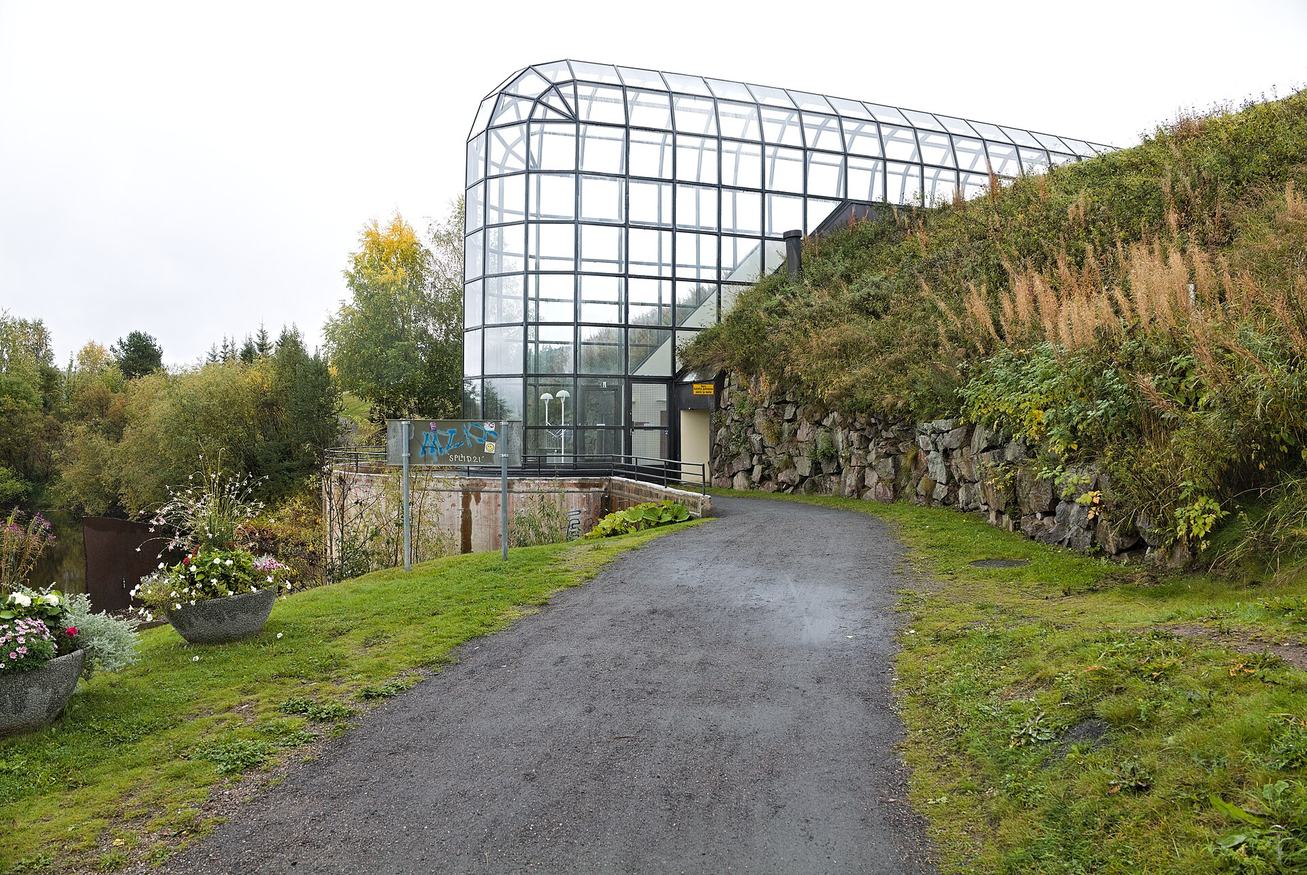
What holds the two halves together is the Arktikum, the museum whose glass tube runs out of a turfed bank towards the river. It handles both the Arctic as a scientific subject and Lapland as a place people live in, including the Lapland War that erased the town. Go there first; the rest of Rovaniemi makes more sense afterwards.
A town with no old buildings is not a town without history. Rovaniemi's history is precisely the reason it has no old buildings.